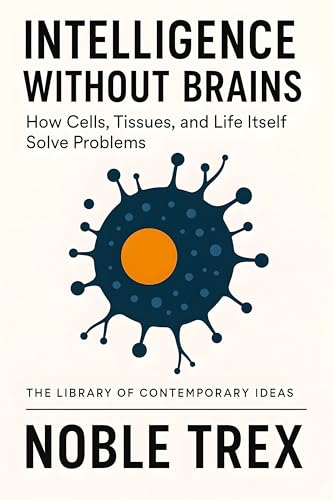

Intelligence Without Brains: How Cells, Tissues, and Life Itself Solve Problems (The Library of Contemporary Ideas)
Trex Noble’s “Intelligence Without Brains” ventures into the largely unexplored territory of cellular and tissue intelligence. This insightful book peels back the layers of biological mystery to reveal how the tiniest of cells and the simplest of organisms engage in sophisticated problem-solving tasks, often believed to require a brain. Through riveting examples and meticulous research, Noble questions our traditional notions and invites readers to witness the autonomy of nature’s many systems.
The book delves deep into the evolutionary marvels that equip cells with the ability to interact, react, and adapt. Noble meticulously dissects various case studies, showcasing the surprising parallels between the cognitive processes of humans and the seemingly primitive life forms. This treatise is not just a descriptive exposition but also a narrative that encourages readers to think about intelligence in a more inclusive manner.
The Problem This Book Solves
In an age dominated by artificial intelligence and cognitive neuroscience, we often pigeonhole intelligence as something uniquely tied to the brain. This perspective limits our understanding and capabilities of what intelligence embodies in the broader spectrum of life. “Intelligence Without Brains” addresses the challenge of viewing intelligence beyond the conventional neural networks, exploring the ingenious ways life forms at their most basic levels solve problems.
Many scientific minds often grapple with explaining how life functions without centralized intelligence — how, for instance, planktons can navigate vast oceans or how plant roots decide where to grow for nutrients. These phenomena raise questions about our understanding of intelligence as isolated to brain-centric organisms. Trex Noble takes on this challenge, proposing that perhaps intelligence is more a trait of life itself, rather than just brains, transcending into cellular and tissue-based solutions.
Key Takeaways
- Understand the concept of non-neural intelligence present in single-celled organisms.
- Explore case studies demonstrating tissue-level decision-making processes.
- Gain insights into the evolutionary advantages of decentralized problem-solving.
- Shift the paradigm of intelligence to include autonomous cellular processes.
- Examine the implications of non-brain intelligence in current scientific research.
Who Should Read This Book
This book is a must-read for scientists, biologists, and researchers who are exploring the realms of cognitive biology and evolutionary theories. It offers fresh perspectives that challenge longstanding principles and could inspire innovative approaches in research.
“Intelligence Without Brains” is also perfect for science enthusiasts and those interested in the broader implications of intelligence across different life forms. It’s a treasure trove of knowledge for anyone curious about how life on this planet functions with precision, often without a central command center like a brain.
Why This Book Stands Out
What sets “Intelligence Without Brains” apart is its unique emphasis on the intelligence inherent in non-brain organisms, bolstered by compelling scientific evidence. While many books explore brain-centric intelligence or artificial intelligence, Trex Noble brings to light the untapped potential of cellular and tissue-based intelligence, providing a fresh perspective on problem-solving.
Noble’s work is not only groundbreaking in its approach but also aims to transform the reader’s understanding of intelligence in the natural world. His ability to articulate complex biological phenomena in an approachable manner ensures that readers are not only informed but also inspired to think more broadly about the capabilities of life itself.
Take the leap into this enthralling exploration by Trex Noble and redefine your understanding of intelligence today with “Intelligence Without Brains.” Act now and be part of the conversation that reimagines life’s intrinsic wisdom.