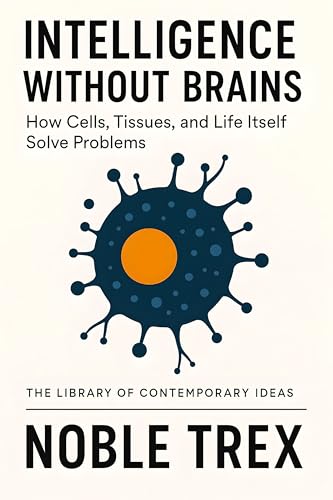

Intelligence Without Brains: How Cells, Tissues, and Life Itself Solve Problems (The Library of Contemporary Ideas)
“Intelligence Without Brains” invites readers on an intellectual journey through the microscopic domain of cells and tissues, showcasing their often astonishing problem-solving abilities. Noble Trex meticulously dissects real-world examples where these seemingly simple biological entities display remarkable autonomy and intelligence.
The book delves deep into case studies and scientific research, exploring instances such as bacterial decision-making processes and the collective intelligence of cellular networks. Trex weaves a narrative that reveals these organisms’ survival tactics as sophisticated forms of intelligence, opening up discussions about the potential applications of these biological insights in technology and innovation.
Perhaps most intriguingly, Trex highlights how understanding these systems can lead to more sustainable, adaptable solutions in our artificial constructs, mimicking nature’s perennial efficiency and adaptability.
The Problem This Book Solves
In a world where intelligence is often attributed solely to beings with complex brains, many underestimate the capacity for problem-solving innate in simpler forms of life. Most scientific discussions about intelligence focus on neural complexity, oversimplifying the vast potential of cellular and tissue-level intelligence that even bacteria and micro-organisms exhibit.
Noble Trex’s “Intelligence Without Brains” challenges this traditional viewpoint, arguing that by broadening our definition of intelligence, we can gain deeper insights into the survival strategies employed by life itself. This approach not only enriches our understanding of biology but could potentially influence how we approach AI and robotics, learning from nature’s most adaptable designs.
Key Takeaways
- Intelligence exists beyond neural structures, manifesting in cellular and tissue-level processes.
- Examples of problem-solving in nature can lead to innovative technologies.
- Understanding biological intelligence can transform AI and robotics design philosophies.
- Nature provides sustainable models for adaptability and resilience.
- Revisiting definitions of intelligence can lead to broader scientific and philosophical inquiries.
Who Should Read This Book
This book is a must-read for biologists, researchers, and anyone intrigued by the mysteries of life beyond the human-centric view. It offers valuable perspectives for those in technology and AI development, presenting unique insights that could inspire novel innovations.
Moreover, individuals with a philosophical interest in the nature of intelligence and the fabric of life will find Noble Trex’s work both enlightening and thought-provoking, challenging preconceived notions and expanding intellectual horizons.
Why This Book Stands Out
“Intelligence Without Brains” stands out for its elegant synthesis of cutting-edge scientific research and accessible narrative. Unlike traditional biology texts, Trex seamlessly integrates complex ideas with relatable analogies and vivid descriptions, making the content engaging for both specialists and lay readers alike.
The book’s multidisciplinary approach not only showcases astounding biological phenomena but also opens dialogues regarding the intersection of natural and artificial intelligence, offering a fresh vantage point that is rarely explored with such depth and clarity.
Discover the underestimated world of cellular intelligence with “Intelligence Without Brains”—a book that promises to transform your understanding of what it means to be smart.